Blog

Optimising Network Reliability and Reducing Customer Interruptions

Optimising Network reliability and Reducing Customer Interruptions: A Case Study of a UK Distribution Network. Written by: Dr Waqas Javed, Team Lead, and Dr David Mills, Head of Net Zero transition, at EA Technology As we move towards a more sustainable energy future, the need for a reliable network is essential; especially as demand and … Read more
The Road to a Sustainable Energy Future

The global shift towards electric vehicles (EVs) marks a pivotal step in reducing carbon emissions and combating climate change. In the UK alone, EV registrations have surged dramatically over the past decade, reflecting a growing public commitment to sustainable transportation. However, such a rapid change presents significant challenges for our existing energy infrastructure. Traditional energy … Read more
Online Partial Discharge detection in MV GIS switchgear

Partial Discharge (PD) can occur in metal clad switchgear operating above 2500V and can have catastrophic results. It occurs in the presence of high voltage field stress and is often undetected until it is too late. Partial discharge has a number of effects that allow it to be detected without direct galvanic connection to the … Read more
Partial Discharge Testing Frequency: How Often to Test for PD?

Understanding the optimal partial discharge (PD) testing frequency is key to maintaining the health of high-voltage (HV) equipment. Regular PD testing helps identify insulation defects early—before they escalate into costly system failures. What is Partial Discharge and Why Does It Matter? Partial discharge refers to a localised dielectric breakdown of a small portion of electrical … Read more
How does an air gap cause PD?

Air Gap Partial Discharge (PD) is caused by a wide range of factors, including poorly fitted insulating materials such as boots, grommets, tie wraps, and sleeving. These materials seem harmless because they are insulating, but can cause PD instead of preventing it. Figure 1: Air Gap Causing PD Example Partial discharge is a tricky thing … Read more
Why so many Partial Discharge measurement units?

Partial Discharge is a poorly understood phenomenon, and it is even harder to understand because many different units are used to measure it. Making matters worse, sometimes you have to calibrate a test set up, and other times you don’t. This article will explain the various units, when and how they are used and why … Read more
How to specify permanent HFCT for future Cable PD testing

Unexpected failures in medium & high voltage (MV/HV) cables cause significant losses in terms of downtime, safety, penalties, and availability. Most of these failures happen progressively and could be predicted from warning signs, most notably, partial discharge (PD). HFCT’s (High Frequency Current Transformers) are used to detect and measure partial discharge in shielded cables. Permanent installation of … Read more
How to analyse PD phase plots (A complete Guide)
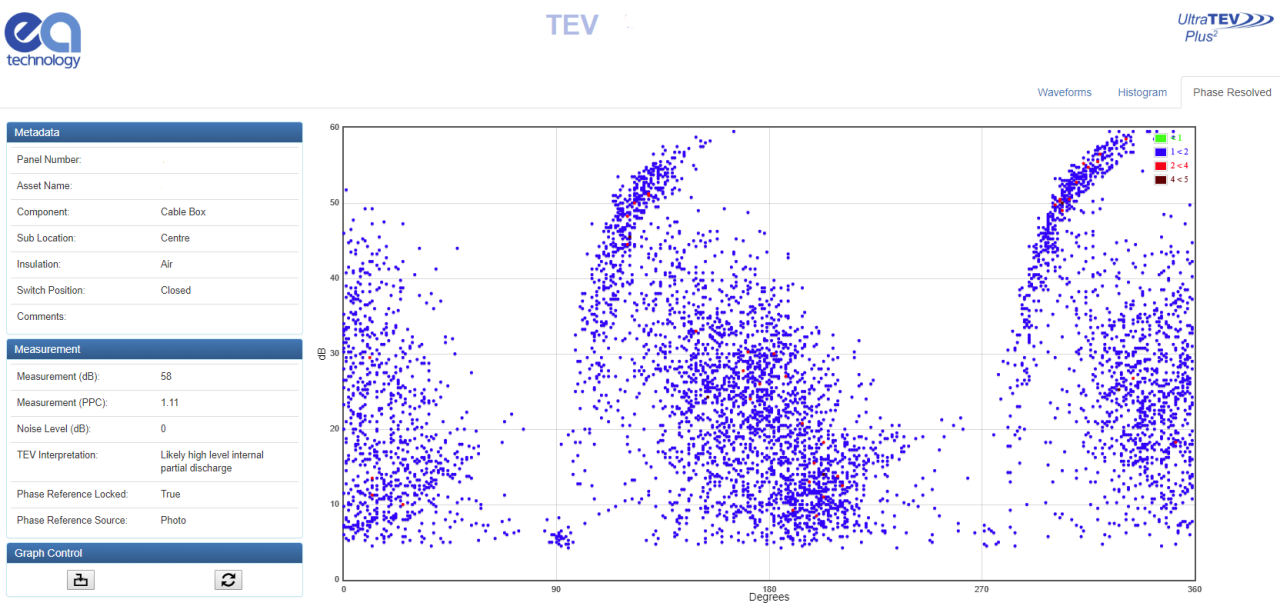
Understanding and accurately analysing partial discharge (PD) phase plots is essential for diagnosing and managing PD in high voltage (HV) insulation systems. This guide provides a comprehensive overview of phase plots, their creation, interpretation, and the critical role they play in PD diagnostics. Introduction to Phase Plots Phase plots, or Phase Resolved Partial Discharge (PRPD) … Read more
UHF Sensor for Partial Discharge Testing

UHF or ultra high frequency testing is one of the most powerful and versatile methods for partial discharge detection in open air switchyards. By using the UHF receiver, the UltraTEV Plus 2 (UTP2) is able to detect partial discharge sources in the UHF band. UHF testing can be utilized as a first pass safety tool … Read more